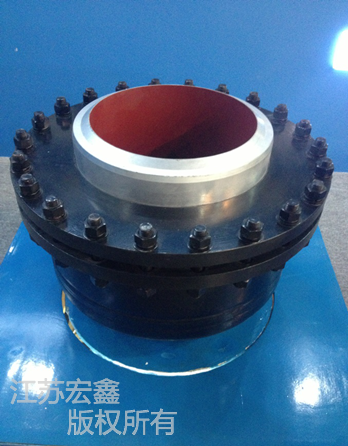
SZG-ZQ high pressure self sealing rotary compensator
Previously only the natural compensation operation was used in high pressure pipelines; other compensation methods could not meet the design requirements. The disadvantage of natural compensation is that every 50 meters in length , 4 elbows are needed to stretch out a segment to form a specific device, and elbow and elastic pipe deformation must absorb the pipeline thermal expansion and contraction. Therefore, it requires a lot of pipes and elbows. In order to overcome the thermal expansion and contraction stress, an elbow and the pipe wall must be thickened, so the material cost increases. Especially under the ultra high temperature conditions, that requires the use of alloy material, which is very expensive, tens of thousands of Yuan per ton. The elbow and the pipe wall must extend for about 30 ~ 40% of the pipe, which requires more and larger space for pipeline layouts with large pressure loss. These requirements make it difficult to meet the operation requirements. Because present pipeline sealing technology can not meet the design requirements , high pressure systems are taking full use of natural compensation technology. For a long time this has made engineering costs very high, while the technology remained stagnant and wasted a lot of money. After years of effort, our company finally succeeded in the development of a high pressure self sealing rotary compensator, and in October 17th 2007 obtained a national invention patent (Patent No.: ZL200610041301.4), and passed the type test of Jiangsu Quality and Technical Supervision Bureau. In a 45MPa super high pressure simulation dynamic running test, there was no leakage, a big improvement. When using a high pressure self-sealing rotary compensator, the compensation length can be up to 10 times as compared to those systems using natural compensation. This can save 30% on pipes and a large amount of elbows. The total investment savings can be as much as 30 ~ 40%, and the pressure drop is only 1/3 of the natural compensation. It is more important that when pipeline thermal stress compensation is completed, the operation process is in a stress free state. The network operation is safer and durable than natural compensation. The high pressure self-sealing rotary compensator is sealed with both a super seal and radial seal, which completely solves the possibility of leakage under high pressure. This is another revolutionary breakthrough in rotary compensator innovations. Now, the compensator compensation method can be used in the petrochemical and power generation industries of high-pressure pipeline pattern.
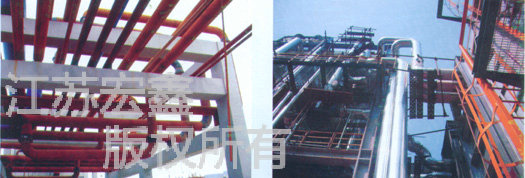
Due to its unique structure, the perfect system for high pressure self-sealing rotary compensator has obtained the attention and recognition of large design institutes. After intense investigation and research, the design concept and quality assurance system of our company, was adopted by the Sinopec design institute, Tianjin Chemical Institute, Sinopec Ningbo engineering company and other numerous companies for chemical industry projects. There are many successful operation cases, like those for the Zhenhai Refining & Chemical, Shuangliang group, Xingang thermal power and other projects. It is currently the only compensator than can be used in high voltage pipelines. We believe that in the near future, no matter in what industry, petroleum, petrochemical, power, or nuclear power, or other fields, our application will be extensively used. The successful application of our innovation in these projects will promote high pressure pipeline compensators into a new era in the domestic petrochemical industry field, fully reflecting the fact that the high pressure self-sealing rotary compensator has incomparable advantages, is more economical, more safe, and more efficient, and will make great contributions to social economic construction!
The chemical process is more complicated, and one process often involves multiple devices, as well as flow and interaction of various media. In order to meet the process requirements and uniform appearance requirements, engineers often specify a pipe gallery layout. But, usually some pipelines are difficult to arrange in the complex gallery, especially the pipelines for high temperature media, such as steam pipes, condensate pipes, compressed air pipes, oil pipes, and some pipes that expand and contract as weather changes. The expansion and contraction of pipes is usually absorbed by a pipe`s natural bending and a corrugated compensator. But as there are number of pipes on a pipe gallery and the stress is complex, the huge blind plate force and elastic force caused by pipe natural bending and corrugated compensator produces great thrust on the pipe rack. This is a threat to the safe operation of the whole pipeline system. The current solution is to increase the amount of civil engineering quantity and the size of the fixed pillar. However, due to working life, quality, and installation precision, etc of a corrugated compensator, this often causes problems, such as corrosion, hunch-up, leakage, and explosions and so on, which lead to shut down or accidents endangering life or equipment, etc. Talking about pipe natural bending, although the security is higher, the compensation amount is small, and thrust is large. Every tens of meters needs a round of extension pipelines. This not only wastes material but also increases on-way resistance, which in turn, reduces pipeline operation functioning and thus increases operation cost. The appearance of rotary compensator brings new ideas for pipe arrangement in the pipe gallery. This brand new compensation method has been accepted by many designers. The following content will briefly outline the method of rotary compensator layout in the pipe gallery:

As (Figure one) shows, when there are many pipes in the gallery and the pipes are long, you can fix both ends and set 2 groups of rotary compensators in the middle, turning up or turning down in a Q form to absorb the thermal expansion on both sides of the long distance pipeline.
When there is no space in the middle to compensate, you can fix the middle of the pipe, with a group of compensators on each side to absorb the thermal displacement.
The above two methods are the most basic form of rotary compensator arrangement in a gallery; you can also mix and combine various ways of compensation according to the actual situation of the pipeline. After using a rotary compensator, a bending pipe is no longer bearing great stress, and fixed pillars are smaller and less than half of the number. This improves security, saves cost and increases the service life of the pipeline. The excellent performance of rotary compensators in the gallery project for the Inner Mongolia Tongliao plum group, Shougang Group, PetroChina (CNPC), Sinopec and other companies pipe demonstrates that the rotary compensator is the newest generation since the ripple compensator, and is the first choice among compensators. At the same time, the rotary compensator is often used in the pipes between chemical equipment to absorb the stress and directly eliminate the displacement of the equipment itself.